Friday, January 15, 2010

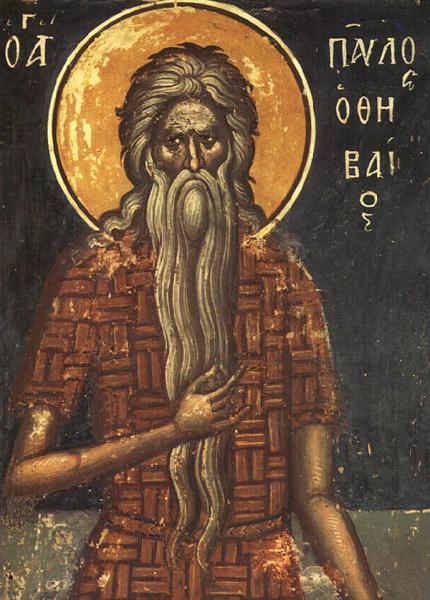
01/15: Day of St. Paul the Hermit, 233-345. (Catholic)

Today is a day that belongs to hermits and cave dwellers.  


In the Catholic church, the saint remembered on 1/15 is St. Paul the Hermit (aka Paul of Thebes), depicted above.  He is also called "the first hermit."  St. Paul the Hermit was reportedly born in Egypt, orphaned at 15, and was considered devout at a young age.  According to American Catholic's website, his seclusion began out of fear, and he stayed much longer than intended: 

 During the persecution of Decius in Egypt in the year 250, Paul was forced to hide in the home of a friend. Fearing a brother-in-law would betray him, he fled in a cave in the desert. His plan was to return once the persecution ended, but the sweetness of solitude and heavenly contemplation convinced him to stay.
He went on to live in that cave for the next 90 years. A nearby spring gave him drink, a palm tree furnished him clothing and nourishment. After 21 years of solitude a bird began bringing him half of a loaf of bread each day. Without knowing what was happening in the world, Paul prayed that the world would become a better place.
American Catholic's biography of St. Paul the Hermit also admits that we do not know how much of this story is true, and how much is fabled.  His story is, however, entwined with and upheld by St. Anthony the Great, the far more famous hermit.

In the Greek Orthodox church, the saint celebrated today is St. John the Cave Dweller.  I wasn't able to find as much about this saint, but I've included a portion of  the reading from the the goarch.org site.  Go here to find the rest of the reading.


Wednesday, January 13, 2010

01/13: Afterfeast of the Theophany of Our Lord and Savior Jesus Christ (G.O)

Today marks the seventh and final day since the Theophany in the Greek Orthodox tradition. It is also called the Epiphany, and is observed on the same day in the Catholic church as well.  This holiday celebrates the incarnation of Christ, and is also intended to mark the manifestation of Christ to the Magi, at his baptism, and at the wedding in Cana.

Below is the liturgy provided by goarch.org, the Greek Orthodox Archdiocese of America's website for today:


At this point, I don't know what Apolytikion or Kontakion means, nor do I know the significance of the icon represented here. As the year progresses, I hope to learn more about this. 

The Greek Orthodox Church also remembers Hermylos and Stratonikos today. Below is a part of the liturgy available regarding these saints:


In the Catholic tradition, today's saint is the French St. Hilary of Poitiers, who lived from c.315-368 and was involved in defending the church against the orthodox heresy of Arianism.  A couple interesting facts about St. Hilary: he did not convert to Christianity until he was in his 30s, and was forced to become Bishop of Poitiers against his will.  He was exiled for not supporting Arianism and for refusing to denounce Athanasius, another early church leader.  His works were read and affirmed by other scholars, including St. Augustine. Below is a representation of St. Hilary's ordination. 


(A quick editorial note: I apologize for not having a post up yesterday; my alarm didn't wake me, and I wasn't able to post later in the day.  I hope to remain on schedule moving forward.)

Monday, January 11, 2010

Having grown up as a Protestant in the Methodist tradition, I had very little contact with either Catholic or Greek Orthodox churches. I consider that a detriment, since these two institutions contain two millennia of tradition, ritual, and thought.

For various reasons, many Protestant traditions have discarded things that could be beneficial to understanding the history of the faith. The traditions of these two great institutions are very different than the many Protestant traditions, and I believe have much to offer me personally.

I intend for this blog to be an extended writing exercise. By following both the Catholic and Greek Orthodox religious calendars, I intend to learn more about the many religious holidays that Protestants either do not observe or do not emphasize to the same degree that Catholic and Greek Orthodox congregations do. I will also write about the different saints that are remembered each day in both faiths, and either provide or link to a biography of these saints. (Do not be surprised if I explore larger themes as well, i.e. differences between G.O., "Protestant," & Catholic beliefs, varying views on sainthood, etc.)

Obviously, I do not write anything here as a member of either the Greek Orthodox or Catholic faith. I do adhere to the Nicene Creed, however, and in that respect have similar foundational beliefs. I do not mean any offense by exploring these things here, and have only the utmost respect for Greek Orthodox and Catholic traditions.

This is also a very web-friendly blog. I will state here that this blog is largely informal, and I will be referring to information made available online for everything I post. For the time being, the sources I will use for the Catholic saints is here, the Greek saints and holidays here, and the Catholic religious holidays here. If I update these sources, I will make a note of it.

New entries will begin tomorrow, and should be updated daily in the morning.